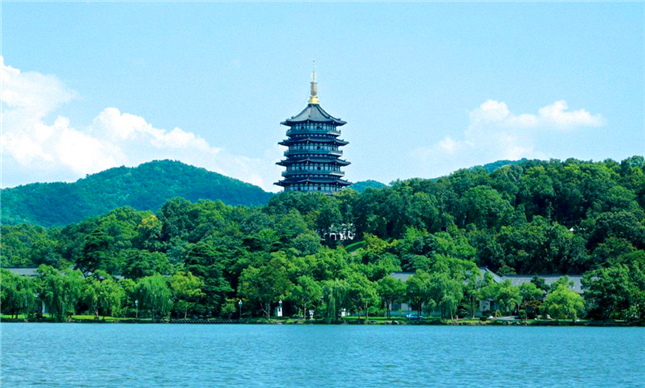
Leifeng Pagoda
Introduction
Leifeng Pagoda, a historically significant structure located in the south of West Lake in Hangzhou, is renowned for its picturesque appearance, especially when illuminated by sunset. Originally constructed during the Five Dynasties and Ten Kingdoms (907-960) period by Qian Hongchu, a king of Wuyue, the pagoda was a dedication to his concubine to commemorate the birth of their son. It derives its name from the Leifeng Hill, upon which it is situated, and has been a landmark of cultural and architectural interest throughout its existence. Despite the trials it faced over the centuries, the pagoda remains a symbol of historical resilience and cultural heritage in the region.
History
Original Construction
The original Leifeng Pagoda was built in 975 AD by Qian Hongchu, a monarch known for his devotion to Buddhism and his efforts to promote cultural prosperity. The pagoda was intended as a testament to his affection for his concubine and as a symbol of celebration for the birth of their son. During its initial construction, it quickly became a revered site due to its elegant architectural style and its prominence on the scenic West Lake, which has long been celebrated in Chinese literature and art for its natural beauty. The pagoda served not only as a religious monument but also as an emblem of the cultural and artistic achievements of its time.
Destruction and Rebuilding
Leifeng Pagoda's history is marked by its destruction and eventual reconstruction. The structure suffered significant damage during the Ming Dynasty (1368-1644) when Japanese pirates set it ablaze, leading to its complete ruin. The pagoda's troubles did not end there; in the 1920s, it fell victim to further misfortune when thieves stripped bricks from its foundations. This looting caused the already weakened structure to collapse. However, the legacy of Leifeng Pagoda did not fade into oblivion. In a bid to restore this iconic monument, reconstruction efforts culminated in 2002 with the completion of a new pagoda on the original site. The modern-day structure, which faithfully replicates the historic design, features five faces and eight stories, continuing the legacy of the pagoda as a cherished cultural and historical site.
Cultural Significance
Legend of the White Snake
Leifeng Pagoda is deeply embedded in Chinese folklore, most notably in the Legend of the White Snake, a tale that has captured the imagination of generations. According to the legend, a white snake spirit transformed into a beautiful woman named Bai Suzhen, who fell in love with a human scholar, Xu Xian. Their love story was met with various trials, one of which was Bai Suzhen's imprisonment beneath Leifeng Pagoda by a sorcerer named Fahai. This legend has imbued the pagoda with a mystical aura, turning it into a symbol of eternal love and the enduring struggle between good and evil. The story has been adapted into numerous operas, films, and literary works, cementing its place in Chinese cultural heritage.
Influence on Literature and Arts
The Leifeng Pagoda, with its rich history and associations with legendary tales, has had a profound impact on literature and the arts. Its image and the stories surrounding it have inspired countless poets, writers, and artists throughout Chinese history. The pagoda frequently appears in traditional Chinese paintings, often depicted alongside the tranquil scenery of West Lake, symbolizing a harmonious balance between nature and human creativity. Literary works, such as poems and novels, often reference the pagoda and the Legend of the White Snake, using them as metaphors for themes such as love, sacrifice, and the passage of time. Its enduring presence in various artistic forms highlights the importance of Leifeng Pagoda as a source of inspiration and a repository of cultural memory.








